What if Chris Paul stayed a Laker?
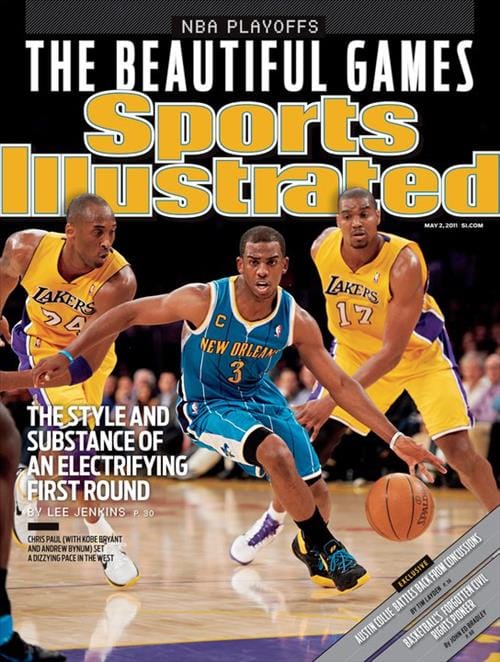
Cannot remember the first time I saw Chris Paul photoshopped into a Los Angeles Lakers uniform. But I can remember the most recent sighting, the night Chris Paul's retirement announcement spread, spotting two separate instances on social media. Lakers fans never got over Chris Paul's Dec. 2011 trade to the Lakers, the NBA's largest deal which didn't count.
They shouldn't get over it, a unique squeeze in NBA history.
The legend should survive. The NBA-owned and operated New Orleans Hornets – the what, and the what-what? – dealt a disgruntled Chris Paul in what appeared to be a suitable haul for Los Angeles, New Orleans and Houston, each team involved in the three-way trade.
The problem wuz the team earning the best player: Dem Lakers. Los Angeles didn't pull in prospects or picks or good players or All-Stars, New Orleans and Houston earned all that, but the Lakers (not quite 18 months removed from a championship) received Paul, a 26-year old franchise player. Los Angeles kept its own best player and retained the assets to deal for Dwight Howard.
The NBA hadn't owned a team before yet here we were in the 21st Century, in David Stern's last go-round, the league forced to carry one of its own like a barnstorming collection scheduling afternoon doubleheaders in deference to the next evening's Ice Capade sellout.
And of all teams to pass along a good player and a great player in exchange for the greatest player, why the Lakers?
The league, after some pressure, rescinded the trade after a few hours.
"WoW," was Paul's reaction on Twitter.
One of the Lakers involved, Lamar Odom, was confused.
Said Odom via his Twitter feed: "When a team trades u and it doesn't go down? Now what?"
Lamar never quite figured out this answer.
For context, the way ESPN's Marc Stein justified the trade at the time:
The proposed trade would have sent Paul to the Lakers, Pau Gasol to the Rockets and furnished New Orleans with three top-flight NBA players in Kevin Martin, Luis Scola and Lamar Odom as well as playoff-tested guard Goran Dragic and a 2012 first-round pick that Houston had acquired from the Knicks.
(Just, "acquired," ESPN. Not, "had acquired.")
It is true the Lakers and Rockets combined to furnish New Orleans with all manner of capable players. The problem was the player the Lakers were thought to be after, possibly even ahead of Chris Paul: Dwight Howard, all-but-MVP, so corny he couldn't help but parrot Shaq's Orlando-to-Los Angeles squawk.
Trading Odom and Gasol left the Lakers with a trade exception plus the services of Andrew Bynum. It cut two massive salaries off Los Angeles' books, and while Los Angeles said "so long" to the NBA's top Sixth Man and most versatile big man, it didn't cost the Lakers a single first-round draft pick.
Cavaliers owner Dan Gilbert tried to get me fired once, but he nailed each and every point in his famous email to NBA commissioner David Stern, CC'd to every media member (but me):
Over the next three seasons this deal would save the Lakers approximately $20 million in salaries and approximately $21 million in luxury taxes. That $21 million goes to non-taxpaying teams and to fund revenue sharing.
I cannot remember ever seeing a trade where a team got by far the best player in the trade and saved over $40 million in the process. And it doesn't appear that they would give up any draft picks, which might allow to later make a trade for Dwight Howard. (They would also get a large trade exception that would help them improve their team and/or eventually trade for Howard.)
The Lakers not only pulled Chris Paul (owed $16.35 million in 2011-12), but the massive savings earned upon jettisoning Odom's $8.9 million 2011-12 commitment and Gasol's $18.7 contract for 2011-12. Odom was already 32 and owed $8.2 in 2012-13, Gasol 31 and with two years and $38.2 million remaining after 2011-12.
Houston's role in the trade was curious, GM Daryl Morey provided the Hornets with 2010-11's No. 9 and No. 27-leading scorers in Kevin Martin (23.5 points per game, in a much slower era) and Scola (18.3 points per game). Two starters on a 43-win team which just missed the playoffs, two Almost All-Stars for one Acknowledged All-Star.
Swapping Scola for Gasol and promoting reserve Rocket (sweet-shooting two-way) off guard Courtney Lee was an upgrade, Martin played little defense. But Houston provided the Lakers with the Buss Family's next franchise star in CP3, someone to carry the 2010s. Leaving Laker room to deal for Dwight Howard because Kobe can't play forever, and the Buss Family always keeps two franchise stars.
New Orleans' takeaway was standard for the time, accepting three cucumbers for a pickle. A Knick first-rounder, plus four good starters (Scola, Martin, Dragic, Lamar Odom) added to a team featuring 29-year old Emeka Okafor and 26-year old Trevor Ariza. For a team under threat of trade demand, a relative bounty.
Los Angeles' bid was obvious. Not only adding Paul, but learning from the lessons left ahead by Celtic Danny Ainge: Boston dealt for Ray Allen at the 2007 NBA draft without yielding the assets needed to acquire its larger target, Kevin Garnett. The Lakers wanted Dwight Howard, soon to set a record for most passive aggressions in a 66-game season. Orlando wouldn't turn down Lakers (2012 All-Star) center Andrew Bynum and a cache of picks for Howard, not while trading Howard 2500 miles away. The Lakers had the pieces to rule the 2010s.
And everyone noticed this, upon re-reading Woj's tweet. Chris Paul is traded, and the first thing out of every NBA fan's mouth is "Dwight Howard."

Fans were not happy. Lakers fans, yeah, cool with it, but the rest of the NBA's followers were somewhat put off but the NBA itself trading a top-five player to the Lakers. While, as even Dan Gilbert noticed immediately, clearing the way for Dwight Howard's acquisition.
The NBA ended its 2011 lockout a dozen days before the deal was made, it cut 16 games from the season while introducing a crammed, 66-game schedule featuring little rest. Familiar with the 1998-99 NBA owners' lockout, fans steadied themselves for a low-efficiency campaign full of bad basketball. The coronation – Dwight and CP3 and Kobe's Lakers meeting Bosh and LeBron and D-Wade's Heat in the Finals – was unappealing in comparison to the parity which threatened throughout 2010-11.
Chicago had the MVP and the league's best record in the season before the lockout, Orlando held Howard and a recent Finals trip, the 56-win Celtics were a year removed from the Finals, win-now the Knicks were set to sign and/or trade for everyone in sight ahead of another lost (2012) first-round pick. Atlanta? Nobody performed with more parity than Joe Johnson's Hawks.
The West was as deep and brutal as ever in 2010-11, a battle of attrition resulting in the emergence of Dirk Nowitzki's Gen X Mavs. Paul's 46-win, No. 7-seed New Orleans group gave the defending champion Lakers first-round fits before Dallas swept the champs in the Western semifinals on the way toward the title.
Now the C's and Mavs were a year older, New Orleans and (presumably) Orlando clipped, the Heat and Lakers destined for the Finals. Americans don't like destiny. We want surprises, however manufactured, along the way.
David Stern noted most of all of this and killed the trade.

LOS ANGELES
Distressed, Odom held out of Laker camp. Three days after Stern rescinded the deal, the Lakers sent Odom and a second-rounder to (hated) Dallas for a protected first-rounder (2014: Mitch McGary) and a trade exception. The deal saved the Lakers $18 million, Los Angeles replaced Lamar Odom with three minimum players (Josh McRoberts, Jason Kapono, Troy Murphy) who absolutely did not replace Lamar Odom.
"To be honest with you, I don't like it," Kobe Bryant said. "It's tough to lose Lamar. Pau (Gasol) is still here, and we're all thankful for that. It's hard when you've been through so many battles with players to just see them go somewhere else. It's tough."
The Lakers, who cut scouting staff from payroll during the lockout, who cut coaching salary in half by switching Phil Jackson for Mike Brown, weren't finished chopping.
The 2012 trade deadline watched Los Angeles use cash and a 2012 first-round pick (No. 24: Jared Cunningham) plus a 2013 pick swap to free themselves from Luke Walton's $6.1 million commitment in 2012-13. The Lakers sent the pick earned from the Mavericks trade to Houston, with Derek Fisher, for Jordan Hill. The move gave the Lakers needed frontcourt help, but also cut another championship favorite (and incoming first-round pick) for a million or two in tax savings.
All was absolved in summer, when the Lakers used the trade exception earned from Dallas to deal for Steve Nash. Los Angeles dealt its role in 2013 pick swap (No. 19, Sergey Karasev), $3 million cash, two second-round picks and the selection which turned into Mikal Bridges for the 38-year old point guard. Later in the offseason, the Lakers sent out the remaining 52 games of Andrew Bynum's career and a first-round pick which did not materialize for Dwight Howard.
None of it worked, the Lakers defended worse and scored with less precision under Mike Brown, Odom's brilliance gravely missed. The Nash and Howard acquisitions fell from injury, wearied by Los Angeles crumbling exterior: Bryant was a large defensive sieve, he usually wasn't the only one in the lineup.
NEW ORLEANS
Six days after rescinding a trade – New Orleans earning the services of Lamar Odom, the No. 9 (Martin) and No. 27 (Scola) scorers in the NBA plus the rights to future All-Star and NBA Third Team member Goran Dragic, plus a Knicks pick – the NBA traded Chris Paul away from New Orleans again.
This time to L.A., the Clippers, in exchange for Eric Gordon, Chris Kaman, Al-Farouq Aminu, and the more favorable of the Clippers' or Timberwolves' first-round pick in 2012.
It was, less.
The pick was "better," Austin Rivers at No. 10 instead of Royce White at No. 16. I can't think of two ex-NBA players I'd like to dine with less.
New Orleans GM Dell Demps, likely under strict orders from the NBA, did little else in the 2011 offseason. He used exceptions from the new Collective Bargaining Agreement to add thin center Jason Smith and small power forward Carl Landry, taking a cheery swig of his own company's cola and not the competitor's, his uncaring boss staring straight through the emptying bottle.
New Orleans tied for the third-worst record in the NBA, and won the rights to Anthony Davis at top overall pick.
Later, they'd trade Anthony Davis to the Lakers.
HOUSTON
The Rockets, as most teams of the era often did, settled upon signing center Samuel Dalembert.
WHAT, IF
Never, ever, thought Chris Paul and 33-year old Kobe Bryant could function well together. Toss in Orlando's aversion to augmenting the league's most popular franchise with another Superman center, and Laker fans won't enjoy my guesswork.
During the 2012 offseason, Orlando traded Howard to Los Angeles in a four-team deal involving Philadelphia and Denver. The Magic earned a first-round pick from the Sixers (later, De'Aaron Fox), a first-round pick from the Nuggets (Dario Saric) and a first-round pick from the Lakers, the Lakers were so bad the pick did not materialize and turned into two second-rounders.
Orlando chose not to take on Andrew Bynum, but instead second-year center Nikola Vucevic, rookie Maurice Harkless, and in-prime defensive guard Arron Afflalo, who topped the (20-win) Magic in points in 2012-13, leading to the Victor Oladipo draft choice.
We paired Bynum and the Magic for so long that the thought of Orlando's own interest in Bynum was taken for granted, the notion was shoved in our face when Orlando GM Otis Smith went well out of his way to pass on dealing for Andrew in 2012. Bynum was in Smith's building during the 2009 Finals, Otis saw plenty and let Philadelphia take the hose, Philly dealing Andre Iguodala for Bynum's Sixer uniform, never worn.
Surely, the Lakers could compile enough capital in the days before the 2011-12 season, compel the Magic with a similar four-team deal. Let's pretend Orlando relents, moves Howard to Los Angeles in time for Christmas, 2011.
Orlando didn't want Bynum or low-20s Lakers first-rounders, but parts could assemble, Howard could become a Laker ahead of 2011-12. Say it happens? A seeming champion at some end, but little makes certain in sports.
Oklahoma City was ready, Miami already there, San Antonio laying in wait.

Los Angeles with Dwight and Kobe and CP3 makes it past OKC in 2012, probably not the Spurs in 2013 or 2014, no titles. Bryant, bolstered by Paul, doesn't rupture his tread. But even with the All-NBA triptych on board plus Metta World Peace, this isn't an all-out lineup. MWP and Bryant are too slow, Paul too small, Howard somewhat all over the place. And the Thunder just imported Kendrick Perkins from way out East.
Let's avoid this. Make some stuff up.
Orlando keeps its Dwight in 2011-12. Philly is still interested in Bynum, who the Lakers deal (with Luke Walton) to the Sixers for Andre Iguodala, Spencer Hawes and rookie Vucevic. Bloggers like me will rue the loss of Vucevic but champion Doug Collins' Sixers for choosing a setting greater than "mediocrity." I'd probably use a line like that, it would sorta make sense.
For starting center, the Lakers use an exception on Samuel Dalembert. As was the custom of the time.
That's a defense. Bryant, Iguodala and MWP aren't exactly spot-up flamethrowers, Paul's assists will dry, but CP3 will routinely connect with Hawes' soft mitts, dunkin' Dalembert and the emerging Vucevic (who, in the real timeline, averages 13 and 12 in 33 minutes per game with the Magic in his second season). Instead of coupling first-round picks to excuse Derek Fisher and Luke Walton, the Lakers can deal the still-lively Metta World Peace for outside help.
It never wins. Weakened by a long first round playoff series against New Orleans, Los Angeles loses to the Rockets in 2012. Weakened by a long first round playoff win against Houston in 2013, the Lakers lose to the New Orleans Pelicans in 2013. This second loss was particularly ignoble, with Iguodala chatting up Pelicans coach Monty Williams courtside during Game 5, reminding Williams of Iguodala's upcoming free agency.
Still, the Lakers (besides Kobe) set an all-time record for two-point percentage in 2012-13. Kobe and Paul fall out routinely but make up just as often due to their presence in the same television commercial filmsets, if not advertising campaigns. In 2019, the Lakers deal Paul to Phoenix for Russell Westbrook.
Don't ask Russell how Russell got to Phoenix.
I never saw Chris Paul and Kobe Bryant as an easy fit, not unless a third major star exhibited major pull on the offense's attention. They'd pile up the wins, surely, and while Chris Paul's post-prime Rocket time with James Harden isn't the greatest summation, it works as approximation.
What is certain is that New Orleans was made worse by the trade's cancellation. Martin made $10 million a year, Odom less, each were free agents in 2013. Scola was a free agent in 2012. All were play-now rentals either designed for a trip back to 40-odd wins (possible) in New Orleans, or a piece-by-piece veteran selloff of Martin, Scola and Lamar Odom, as orchestrated by a team owned by the NBA (less possible).
A selloff, with its respective 2011 values, could prove bountiful. Meanwhile, Goran Dragic twirls around New Orleans for the next dozen years.
Instead, Eric Gordon worked 221 out of a possible 394 games in New Orleans, making the most money on the club throughout his term. In 2016, the Pelicans let Gordon (who still plays) walk to Houston in exchange for the cap space to sign E'Twaun Moore, Solomon Hill and Langston Galloway to over $90 million of guaranteed salary.
Al-Farouq Aminu started three-quarters his games with New Orleans, leaving as a free agent in 2014 to join Portland. New Orleans traded for Omer Asik and Omri Casspi to fill his shoes.
Chris Kaman made over $14 million for 47 games as New Orleans Hornet, leaving in the 2012 offseason as a free agent to join the title-seeking Mavericks.
Just before then, Tom Benson bought the New Orleans NBA franchise from the NBA for $338 million. NOLA immediately dealt Okafor and Ariza for Rashard Lewis' untradeable contract (read: payroll relief), turned three second-round picks into Robin Lopez (plus $1.5 million from the Suns).
Benson let Demps deal for Ryan Anderson's 16 points per game (Anderson earned several Sixth Man Award votes), and match Phoenix' four-year, $58 million offer sheet for restricted free agent Eric Gordon. Money well-spent to buttress rookie Anthony Davis.
Whom New Orleans dealt to Los Angeles.
Later, Los Angeles dealt Davis for Luka Dončić.
MY WAY OF GIVING
Thank you for reading!
NEXT: CLIPPERS, ANTHONY DAVIS